
A Pump, a Plan, and a Lot of Feelings: My First SCIg at Home
I don’t just live with a rare neurological condition called Chronic Inflammatory Demyelinating Polyneuropathy—apparently, that alone wasn’t quite dramatic enough.
To fully commit to the plot twist, I also live with its rarer variant: Lewis-Sumner Syndrome.
Because really, why settle for a pain in your ass when you can have a disease no one has ever heard of… or can pronounce, for that matter.
In 2022, I began IVIg treatment (intravenous immunoglobulin, a therapy delivered directly into a vein that requires regular hospital stays).
Because it meant frequent hospitalizations, I recently decided to take a leap of faith and transition to SCIg (subcutaneous immunoglobulin, a form of the same therapy that can be self-administered at home).
Previously, this option was not available at the hospital in Przemyśl, in the southeast of Poland.
My first SCIg infusion after training was scheduled for Monday, December 8th. Unfortunately, that day was already packed, and rescheduling wasn’t an option—so I had no choice but to do it on Sunday, December 7th instead.
It’s been almost two weeks since my last SCIg training session at Father Pio Hospital in Przemyśl, and during that time, my brain has been very busy producing its own collection of worst-case scenarios for my first treatment at home.
There were plenty of contenders, but these three were the clear winners:
- What if I drop the bottles of precious HyQvia immunoglobulins, they shatter on the floor, and my medication is lost forever—followed shortly by my arrest and a lifetime sentence in hospital jail?
- What if I accidentally pump a bubble of air into some crucial abdominal artery and it calmly travels straight to my heart or brain, killing me instantly?
- What if the pump suddenly starts spewing smoke… and, naturally, there’s absolutely no troubleshooting section for that in the instruction manual?
I was at physical therapy last week, and when I expressed my concerns to my physiotherapist, he reassured me in a long explanation backed by evidence and anecdotes that these scenarios are absolutely impossible. No one from the medical world would let me do this at home if there were even the slightest risk of any harm, so everything is completely safe and comfortable, and the pump itself is for sure easy and intuitive to use.
In other words, the whole SCIg setup is basically “idiot-proof “, so I have nothing to worry about.
Under different circumstances, I might have been slightly offended—but I knew he was right, and funny enough, that realization was exactly what calmed me down.
For a while at least…
It was actually good to have my rehab sessions between SCIg training in the hospital and my first home infusion. For one, they kept my mind off imagining every possible disaster scenario, and for another, the massages and heat lamp helped me relax.
At this point, I must thank my therapist for guiding me to this realization—and for putting up with my mood swings, my anxiety, and muscle tension.
I’m almost certain he’s already planning a yoga retreat – just to recover from seeing me freak out over my first home SCIg for ten days straight.
Honestly, I wouldn’t be all that shocked; I’m acutely aware that working with chronically unwell people can be exhausting, and I might accidentally nudge him toward that classic burnout that’s all too common in medical and social services.
Alright, moving on, because when it comes to worst-case scenarios, I still have more surprises to offer. I am very creative that way.
So, in the ‘more cinematic’ category, these are an absolut winners:
- A tsunami in the Baltic Sea (I live about 550–600 km / 340–375 miles away, but since it’s my scenario, I allow myself some creativity),
- An earthquake in the Bieszczady region where I live (on 9 October 2023 there was a 5.2‑magnitude quake in Slovakia, the tremors were reportedly felt in parts of Bieszczady so that’s not completely far-fetched),
- Or war reaching Poland’s eastern borders—which, sadly, feels like the most realistic option.
And then—what exactly do I grab first?
Because now I suddenly have more “luggage” to carry, including a cooler bag full of a very important medication.
Clearly, this is something I need to be prepared for. Just in case.
Of course, none of this had any real chance of playing out.
I was simply creating a bit of absurd drama—my own way of showing just how absurd my anxiety had become.
Besides these ridiculous scenarios I made up to amuse myself, I also had some very real fears:
- Could I actually do it all on my own without helpful nurses?
- What have I remembered and what have I forgotten from my SCIg training?
- Was I smart/focused enough to follow the instructions correctly?
- Would I be able to stay calm if troubleshooting the pump became necessary?
- Did I have the guts—the courage—to face it all?
- Could I manage my stress well enough not to faint in the process?
But my most serious fear was that my left hand—affected by CIDP—would fail me. It has improved significantly after years on IVIg, but some of the nerve damage is permanent.

My hand never fully regained its strength or motor skills—and likely never will. I still struggle with small, precise finger movements, and the coordination and fluidity of my arm, hand, and fingers are gone for good.

SCIg procedure requires both hands - needs these movements as you poke your own stomach, or fill the syringe with HY - very crucial steps.
As I was hyper-fixating on my SCIg situation, my nerves steadily escalated until I started experiencing clear signs of a serious stress reaction: insomnia, sweaty palms, mood swings, trouble concentrating, and a complete loss of appetite.
The result?
I lost two kilos (US – 4.41 pounds).
I kept reminding myself over and over why I was doing this and what it would mean for me down the road: more freedom, fewer hospital stays, fewer trips, fewer blood tests, and basically less of all the hospital-related anxieties.
SCIg At Home – So This Is What Independence Looks Like
Well, it’s tough, but the die is cast—as we say in Poland.
On Sunday morning, December 7th, I put the cooler on my bed and stared at it with a dull, slightly dramatic gaze.


Then it suddenly occurred to me that if I stopped being ridiculous, didn’t die that day, and managed to turn this into a new CIDP treatment routine, this cool new cooler actually had the potential to become my new travel luggage.
Who knew where in the future it would accompany me?
I have to admit that this was a very cheerful and uplifting idea!
Then I looked at the ‘Takeda’ logo and thought it looked like a sponge cake with strawberry filling—which I also found very amusing and delightful.
I’ve realized that when I’m scared out of my mind, my brain occasionally throws me a few amusing and delightful thoughts—presumably as its own way of helping me cope.
Then it occurred to me that the word “Takeda” sounded kind of Japanese, so I wondered what it actually meant.
Maybe it meant something motivational like “Go for it!”, or “The sky’s the limit!”, or even “You got this!”.
Out of curiosity—and partly as an excuse to delay my impending SCIg maiden flight—I decided to check online.
I discovered that “Takeda” is actually a common Japanese surname, written with the kanji 武田.
The first character, 武 (take), means “warrior,” and the second, 田 (da / ta), means “rice field.”
So literally, it’s “warrior’s rice field.”
It wasn’t the inspirational phrase I was hoping for—but somehow, knowing that the word contains “warrior” actually made me feel a bit great.
After all, aren’t I calling myself a CIDP warrior right here on this very blog?
I’m a bit shy about it, though, because too often I feel more like a survivor than a warrior in this CIDP game.
The whole “warrior” idea actually comes from my American background, where people with long, demanding illnesses often call themselves “warriors,” meaning they face their challenges with resilience, courage, dedication, and discipline.
I’ve learned the hard way that without a good dose of resilience, courage, dedication, and discipline, living with a chronic illness can be tough—not just for me, but for everyone around me, too.
Anyway, there’s something motivating about having a warrior’s spirit baked into a name—even if it’s just the name of a company.
Warrior is the first word that hit me, but the “rice field” part I left unattended—until I realized that living with a chronic illness is a lot like wading through the mud, just like rice field farmers do.
Hmm. I suppose I can be unexpectedly philosophical at times… now and then, I manage to produce a little pearl of wisdom.
But isn’t that actually very true?
Isn’t living with a chronic illness exactly like slogging through a muddy rice field?
- Some days you’re knee-deep, moving inch by inch, wondering if the mud will ever let go of your boots.
- Some days the water rises, and you have to figure out a whole new way to move.
- And yet… rice fields are places of growth, patience, resilience, and work that only someone with exceptional strength can do day after day.
So, after having a bit of fun with the logo—and feeling quite proud of the depth of my own thinking—I briefly decided that this would be the perfect moment to start learning Japanese. (Anything to procrastinate).
But I couldn’t put it off any longer.
I headed to the kitchen for a cup of my second espresso that day (because apparently the sweat circles under my armpits weren’t big enough already) and got started on the SCIg setup with all the gear from my cool cooler.
First SCIg infusion At Home – My Maiden Flight
- First, I pulled out my pump instructions and infusion diary. Then I scanned the QR code the Takeda lady gave me, which opened www.madraopieka.pl on my iPad, so I could follow the steps they posted there.


- I skimmed a few pages of the Saphire pump instructions to make sure I understood how to fill the infusion line before connecting it to the line I used after injecting HY. My mind went blank—I had forgotten that part from the SCIg training session, so I had to figure it out on my own.

And yes – the pump is indeed very intuitive and easy to operate for the patient, given it’s preset by the doctor, so basically all I needed to do was to learn filling the line and then press the “repeat the last infusion”, once I connected the lines after injecting HY.
- Next, I started by washing my hands, disinfecting the space, and unpacking everything from the cooler bag. I had forgotten to bring my mat from the hospital, so I had to manage without it.
At that point, I didn’t care—I needed guts that day, not a mat.

- I filled the syringe with HY and primed the lower part of the infusion line that connects to my abdomen. Then I desinfected and grabbed a fold of skin and inserted the two needles, securing them in place with a clear bandage.

- As I was waiting 10 minutes for HY to work, I filled the infusion line with HyQvia.

- When that was done, I pressed Repeat the last Infusion on the pump. I didn’t have to worry about the speed because it was already preset.

- Then I just lay there, dazed, with a mix of stress, disbelief, and happy excitement for the next 3.5 hours, watching the immunoglobulin slowly drip into the chamber and then travel through the line under my skin.
I couldn’t read, go online, or even watch short videos—I could not focus on anything, I was just too exhausted from the emotional roller coaster leading up to the infusion.
I felt relieved that I managed to set up the SCIg all by myself, and it was working.
When I finished at 4:30 pm, I couldn’t even describe how utterly flabbergasted I felt.
I couldn’t believe I had just performed a medical procedure on my own body — one so important it could change the way I fight CIDP forever.


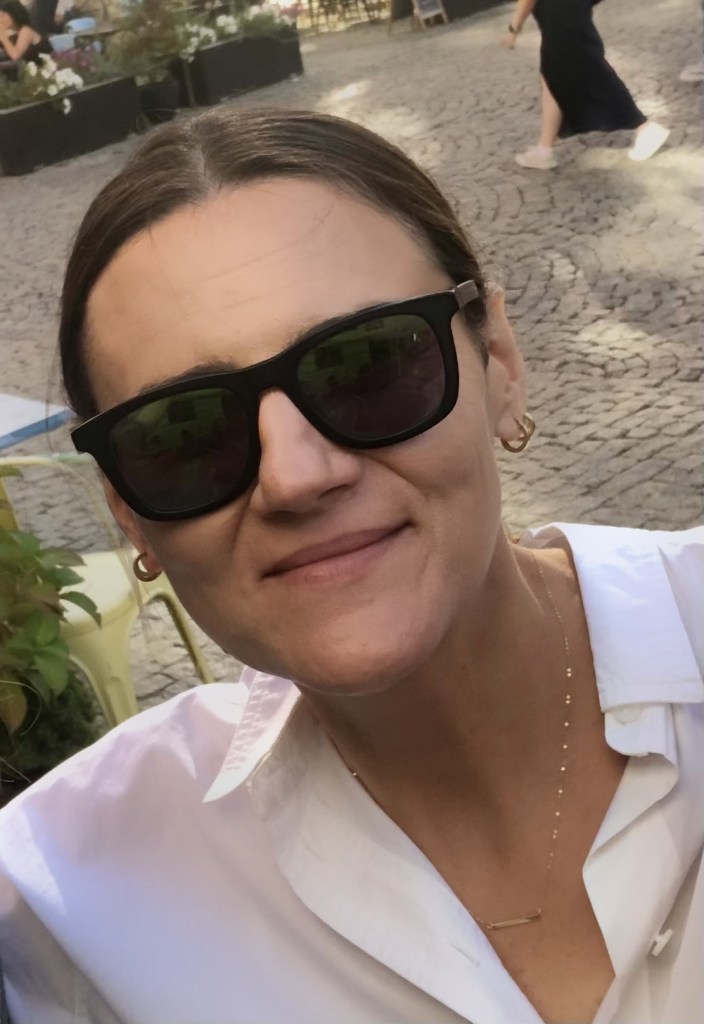
(photos: pump about two hours into the treatment; feeling victorious; and my abdomen after the SCIg home infusion – no swelling and no pain. A big contrast to my third SCIg training session)
And that wraps up my first home SCIg infusion.
I won’t pretend I wasn’t scared — sometimes, I like to think fear is just our mind’s way of saying, “This matters”.
Now that it’s done, I’m tired in that bone-deep way only fellow CIDP warriors know… but also genuinely happy.
Happy that this might mean gentler days ahead.
If you’re about to start your own SCIg journey, take a deep breath. You can do hard things, and you’re allowed to be scared while doing them.
While I was cleaning up, I remembered thinking back in the hospital during training, “If I can manage this, surely I can handle anything maybe, in the not-too-distant future, I could even operate on my own hernia”.
I smiled. Clearly, my imagination thrives under pressure.
Disclaimer #1 — Not Medical Advice
I’m a CIDP patient, not a medical doctor. Everything I share here comes from my personal experience, not from medical training. Always talk to your healthcare provider before making decisions about your health.
Disclaimer #2 — About the Name “Takeda”
And yes — before anyone asks — I’ve become something of an expert on Japanese names in the last 24 hours, thanks to a handful of notes I dug up online.
I’ve come across various interpretations of this name — most commonly “bamboo field” or a toponym meaning “military/rice field.” The “warrior” reading of 武 connects to the Takeda clan’s samurai legacy, but it’s not the standard translation.
Still, I’m choosing to stick with my own interpretation: “warrior’s rice field.”
Why?
Because it gave me the pep talk I needed, lifted my spirits, and reminded me I’m here to encourage myself — not to write a linguistic dissertation on Japanese etymology.
CARING IS SHARING – IF THIS SUPPORTED YOU IN ANY SMALL WAY, SHARING IT MAY SUPPORT SOMEONE ELSE WITH CIDP, MMN, GBS, OR SIMILAR CONDITION, AND SUBSCRIBING KEEPS THIS CIRCLE AND AWARENESS GROWING
SOURCES:
https://www.wisdomlib.org/names/takeda
https://www.takeda.com/about/our-company/history



Leave a Reply