The Day My CIDPJourney Crossed with Others’
I live with Lewis-Sumner syndrome, a rare variant of Chronic Inflammatory Demyelinating Polyneuropathy (CIDP).
Saturday, November 29th, 2025, is the date I’ll probably remember till the end of my life.
That day, I met a handful of CIDP Warriors in Kraków, Poland.

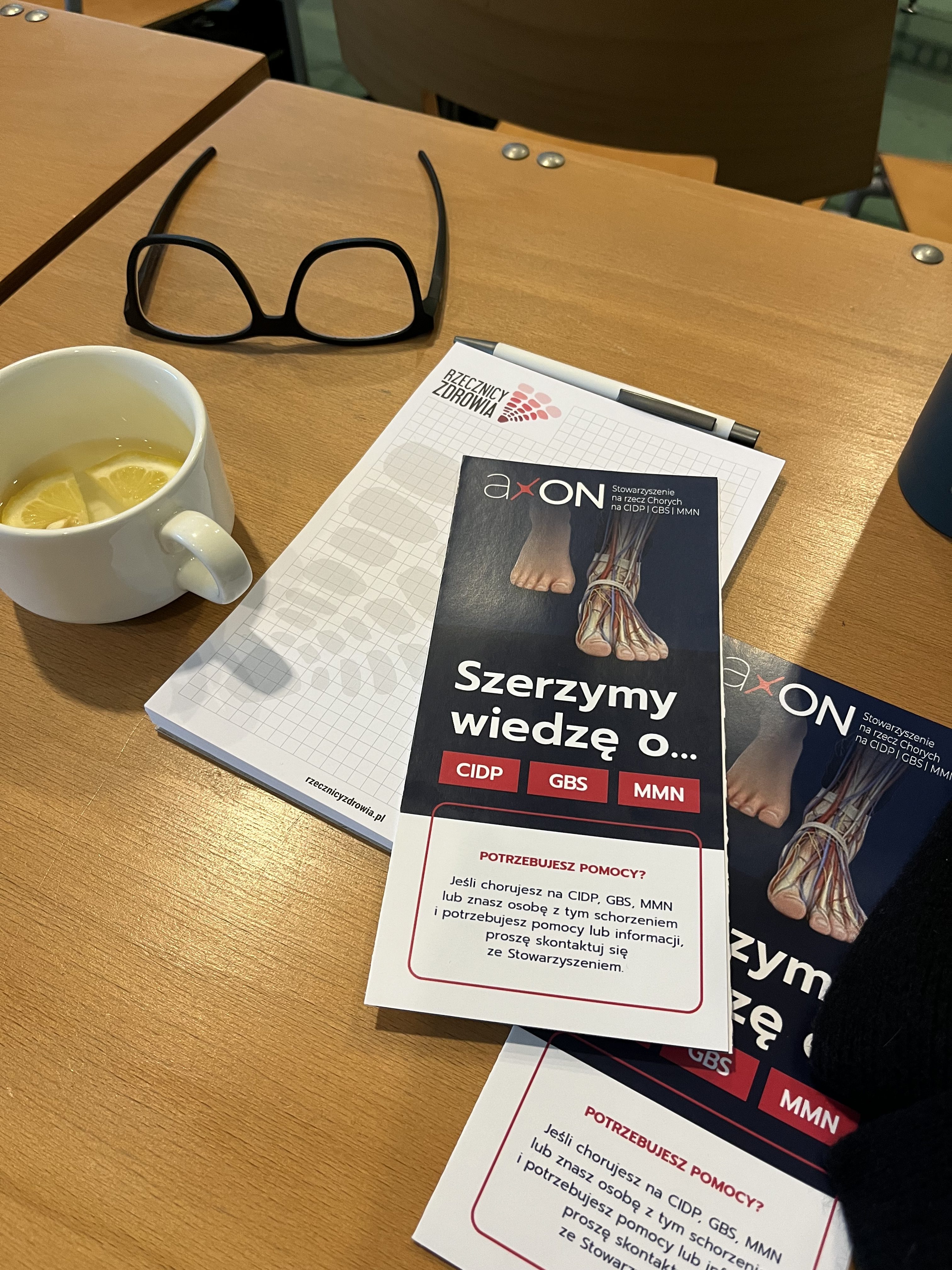
The information at the bottom of the flyer I got at Father Pio Hospital in Przemyśl says: “Takeda is the organizer of the educational workshops for patients.
This material is intended for physicians to provide information about workshops dedicated to patients. The material was prepared at the initiative of and funded by Takeda”.
However, there are two additional logos visible: Health Advocates (Rzecznicy Zdrowia) and axON – Association for People with CIDP, GBS, and MMN (Stowarzyszenie na rzecz Chorych na CIDP, GBS, MMN), which suggests that the initiative was a collaborative effort.
It was held at the Didactic and Conference Center of the Collegium Medicum, Jagiellonian University, on St. Lazarus st, Kraków, Poland.
I learned about this event in Przemyśl, Poland, while attending SCIg training.
When I received the flyer, I wasn’t sure I’d be able to go—I felt like my energy budget was on the verge of collapsing.
I went home, left the flyer on my desk, and started weighing the pros and cons of the trip.
The cons quickly took over.
It was a long journey from where I live to Kraków—about 300 kilometers (about 185 US miles).
I was still in the middle of SCIg treatment training and trial, and dealing with its side effects: feeling shaky, groggy, and exhausted.
My last SCIg day at Father Pio was on November 24th, and the event was scheduled for the following Saturday.
In between, I had already started physical rehab, which meant for that day to get up earlier than usual, going to rehab first, and then heading straight to Kraków. To arrive at a reasonable hour, I’d have to beat both rush hour and winter darkness (the days are very short in Poland at that time of year).
Then there were the practicalities: fuel costs, a hotel stay, and the inevitable question—did I really have the budget for this, especially right before Christmas, when expenses seem to multiply for no good reason?
All my reasoning pointed in one direction: staying home and participating online.
However, there was one strong pro—one good reason that ultimately tipped the scales. I wanted to meet other people living with CIDP.
I wanted to see their faces and hear their voices.
I had never met anyone with CIDP in person before, and I had never asked at Father Pio either—because you simply can’t. No one would ever give you a name; patient data is protected by law.
Since my diagnosis, I’ve often felt like a unicorn—because of CIDP itself, but also because I live with a rare variant of it: Lewis–Sumner syndrome.
I’ve indeed connected with one person who has the same condition, but he lives in Lisbon, Portugal. We’ve exchanged a few messages on Facebook, and even that small connection has meant a great deal to me.
He occasionally likes my FB posts, and I so appreciate this quiet, ongoing thread of understanding we share.
So I kept going back and forth—should I go or shouldn’t I?
What was the right thing to do?
I do have a very close friend who lives in Kraków. We met in our twenties while studying social work. (Aside from my UMCS master’s degree, I also hold a bachelor’s degree in Family Studies/Social Work from a college in Kraków.)
Even though our lives took completely different directions, we managed to stay in touch over all these years.
We catch up, we know what’s happening in each other’s lives, we cheer one another on—and when we finally meet, we simply pick up where we left off. As if no time has passed at all. As if we’d been living in the same neighborhood and seeing each other every day.
My friend Eva is an old soul—generous, kind, funny, and über intelligent. I can only say that I’ve been incredibly lucky to have her as my friend.
I knew she’d be happy if I called and asked whether I could stay with her that weekend. But Eva and her family—her husband and daughter—are avid travelers, and she’s often away, so I wasn’t sure I could just call and barge in on such short notice.
So here’s what I decided: I put everything in Eva’s hands. If she said, “Yes! Come over, we’re home,” I’d take it as a sign that I should go. If she said, “No, I’ll be away that weekend,” then I wouldn’t go.
Simple.
Almost fate-like.
When I texted Eva, she not only said yes—she got really excited about our unexpected get-together and immediately started planning an evening of entertainment. Just as I knew she would, because that’s simply who she is.
Kraków is a lively city, full of culture, great food, and endless places to go, so there was really no other way it could have unfolded. Being in Kraków and not going out would be like being in the Vatican and not seeing the Pope—it just wouldn’t make sense.
That left one last question: the cost of the trip. And that, too, somehow resolved itself.
This year, I slashed my Christmas budget in half, saving energy and money for what really matters to me.
This year, I’ll be the present—all wrapped up in good humor, patience, and cheerfulness.
For that reason, I’m already training myself to be extra nice and less sarcastic—and to bring as much of my sunny side as possible. That should do.
So finally cutting to the chase…I hit the road after my rehab and arrived in Krk already on Fri.
I didn’t get much sleep the night before the meet-up, caught between anxiety and excitement, so I entered the room with a pounding headache—but I had a painkiller in my bag, just in case.
Upon entering the room I was warmly welcomed by Mrs. Markiewicz from Health Advocates, whom I had contacted earlier by email to register. She had somewhat a kind, motherly presence, which immediately helped ease my nerves.
Shortly after I got to know Mrs Wierzowiecka, who I believe initiated “axON,” the CIDP association in Poland, and is a CIDP patient herself.
The workshop began at 10:00 AM, and here is the English translation of the CIDP meet-up schedule that I received by email a few days before the whole thing.
EVENT PROGRAM
10:00 – 10:10 | Opening of the meeting
• Marta Markiewicz, Health Advocates Foundation
• Lucyna Wierzowiecka, axON Association for Patients with CIDP, GBS, MMN
10:10 – 11:00 | From symptom to diagnosis
Dr. Bartosz Kołodziejczyk, University Hospital in Krakow, Neurology Clinic
– Introduction to neuropathies
– CIDP as a specific type of neuropathy: symptoms, etiology, diagnostics
– Co-existing conditions and their impact on treatment
11:00 – 11:10 | Break
11:10 – 12:00 | Tailored treatment
Dr. Bartosz Kołodziejczyk & Dr. Elżbieta Klimiec-Moskal, University Hospital in Krakow
– Steroid therapy, plasmapheresis – pros and cons
– Immunoglobulins – B.67 drug program
– Monitoring treatment effectiveness
– Is remission and symptom withdrawal possible?
– Second-line treatments and current research directions
12:00 – 12:30 | Q&A and discussion with experts
12:30 – 13:10 | Lunch
13:10 – 13:50 | Activities of the axON Association
Lucyna Wierzowiecka, President of axON
13:50 – 15:20 | How chronic illness changes our lives – about people, emotions, and support
Dr. Aleksandra Tomaszek, Clinical Psychologist, Medical University of Warsaw
15:20 | End of the workshop
During the event, you will:
✔ Gain practical advice on treatment and daily functioning
✔ Learn from the experiences of other patients
✔ Speak directly with doctors and experts
✔ Receive a solid portion of knowledge and space to share experiences
From 10:00 AM to 3:20 PM is just a little over five hours—only five hours for a disorder so mysterious that I don’t think even 100 hours could do it justice for the participants. It’s just a short time, and there’s simply no way to cover everything in that span.
But it’s a good start.
CIDP is such a rare and complicated disease that it’s hard to expect any workshop to cover everything perfectly.
It takes a lot of hands-on experience to truly understand and meet the needs of CIDP patients, and from my own journey through diagnosis, I can tell that this experience is often still lacking, in Poland at least.
Even so, these workshops are a step in the right direction.
During the event, I didn’t feel free to walk around and take photos of the participants, nor was I bold enough to ask for a picture with them.
It felt like a no-disclosure approach might be the most respectful choice in this setting, allowing everyone to share and participate without feeling exposed.
But I have taken few pix of what I saw in front of me:


(Photos source: my own shots, taken at the event)
The photos feature two lecturers, both medical doctors listed in the event program, along with supporting slides related to the topics covered, as detailed in the program.
The two bottom photos show the following: on the left, an illustration of how hyaluronidase (HY) works in the body before an SCIg infusion—a part I found particularly interesting after my training; on the right, a visual explanation of how demyelination occurs in neurons.
What CIDP Can Take—And How Quickly
There were only a handful of participants—unsurprising, given how rare CIDP is—with some joining online. We had the chance to speak directly with specialists, which created a valuable moment to share experiences and ask questions.
Listening to others, I also learned just how brutally this disease can strike.
It can sweep you off your feet, both figuratively and literally.
Like the eye of a tornado, within months or even weeks, it can vacuum in your health, both physical and mental, family, social life, education, work, and lifestyle —completely.
All the pillars of your life are rearranged—unapologetically and without warning.
CIDP changes EVERYTHING the moment the first symptoms appear.
Harsh and sobering doesn’t even begin to describe it…
The Stark Reality of Living with CIDP no matter the variant
As I sat there listening to people share their stories, I was struck by a sudden wave of unexpected emotions—a mix of imposter syndrome and survivor’s guilt.
My own Lewis-Sumner seemed to shrink in comparison, and for a moment, I felt both humbled and unsettled—aware of how differently this disease can hit others, and yet grateful for the stability I still have.
That stability, I fought hell and back to achieve, enduring humiliating experiences with some medical professionals I’d rather not even speak of and would probably prefer to forget.
The stability that comes from making some kind of peace with the disability, the regular immunoglobulin treatments, and the chronic nature of this condition, because it’s something I will live with forever.
It is a real ” warrior’s rice field”, and even though it may be gentler than what others experience, it remains a constant presence—the paresis in my left arm and hand, the pain in my other arm and hand as it compensates, my hernia issues, chronic fatigue, and hospital phobia—each making this CIDP journey uniquely mine.
Through all of this, I realized that CIDP is far more complex than I had thought before the meet-up.
I can’t expect anyone to fully understand my own journey with it, and honestly, there are times when I’m not able to absorb everyone else’s struggles either.
All I can do is listen, internalize, learn, and respect their journey. And mine too.
At the same time, I also have to resist both imposter syndrome and survivor’s guilt about my ‘light’ variant—which, in truth, isn’t light at all, considering everything I’ve had to give up just to stay mentally and physically afloat.
CIDP experience – Riding the Waves of Change
Living with a chronic illness like CIDP means learning to stay flexible on so many levels —about your medical doctors, treatment, your lifestyle choices, fitness regimen, your diet, and even the people you allow into your life.
Some people will arrive and offer unexpected support; others may quietly disappear.
Accepting that shifting reality can be a bitter bite to swallow, but it becomes part of adapting, healing, and moving forward.
It’s a constant balancing act: setting boundaries to protect yourself while staying open to anything and everything, because your situation can change in an instant.
You’ll face many paradoxes along the way. I did.
You’ll learn to be resilient, motivated, and disciplined, and to pick yourself up even when no one else is receptive to your invisible disability, rough days, sadness, fatigue—because it’s unrealistic to expect people to always be there.
In moments like these, I turn inward, and what sustains me is my faith in God—an acknowledgment that there is a higher power beyond me, and a conscious act of entrusting myself to its care. I am an old school that way.
But that’s just me; I realize it is not for everyone. And that’s OK too.
Hope and Connection in the Midst of CIDP
Reflecting on the workshop, I feel hopeful.
Even though the time was short and the challenges immense, being in a space where experiences were shared, questions were answered, and journeys were respected reminded me that none of us face CIDP alone.
Every story, every conversation, every moment of understanding adds a small light in what can feel like a storm.
And sometimes, that light is enough to remind us that resilience, compassion, and connection are just as vital as any treatment.
Special Thanks
A heartfelt thank you to my friend Eva, her husband Tomas, her daughter Alexandra, and her wonderfully caring father—without your encouragement and hospitality, I don’t think I would have made it.
I’m also deeply grateful to all the organizers mentioned at the beginning of this post. Thank you for sharing your knowledge and expertise, and for the delicious lunch catering that made the day even more special.
Disclaimer: Everything shared here comes from my own journey with CIDP and is meant for reflection and support, not medical guidance—your healthcare team is always the best source for personal medical decisions.
SHARING IS CARING – IF THIS SUPPORTED YOU IN ANY SMALL WAY, SHARING IT MAY SUPPORT SOMEONE ELSE WITH CIDP, MMN, GBS, OR SIMILAR CONDITION, AND SUBSCRIBING KEEPS THIS CIRCLE AND AWARENESS GROWING


Leave a Reply