CIDP, Lewis–Sumner, and My Long Journey to Naming the Beast
I live with CIDP — specifically the rare Lewis–Sumner Syndrome variant.
After years of painful, frustrating twists on my diagnostic path, I was desperate for answers.
Why were my left hand and arm slowly — but unmistakably — refusing to live a peaceful, functional life with me?
Why were my muscles spasming, my nerves growing weaker, and my hand ignoring even the simplest instructions?
What was causing my left arm and hand to wilt, quite literally, before my eyes?
In December 2021, at Father Pio Hospital in Przemyśl in southeast Poland, I finally came closer to understanding what had been happening to me — an understanding I thought might never come.
Around that time, I was already at the end of my wits—whatever was left of them and I was seeing a psychiatrist and taking SSRI antidepressants.
Every fragment of hope seemed to crumble, dragging the last shreds of my mental health along. On top of that, my arm and hand were in severe paresis, basically dangling on my left side like a sad, broken branch, with an ulnar claw (aka griffin claw hand) as if added purely for more dramatic effect.
So no wonder this particular hospital stay was a turning point on my CIDP journey — the first time the doctors were able to identify the disease and finally give it a name.
A significant leap forward toward the correct diagnosis was achieved.
They suspected Multifocal Motor Neuropathy (MMN) and recommended IVIg (immunoglobulin infusion) as treatment. However, before starting, I needed a second opinion at the “clinical level.”
This left me with two options: a clinic in Rzeszów or one in Lublin — and I chose Lublin.
So off I went on another cruisade.
I kept calling clinic in Lublin, also sent copies of my med exams requesting second opinion but due to COVID they weren’t taking any patients.
That way the clinic was off the table.
Feeling like I was finally getting somewhere and not willing to give up, I decided to see a doctor at the Specialized Neurological Medical Office on Kraśnicka Avenue in Lublin — the same place where I had my first EMG back in March 2016 (which, by the way, had come out fine).
I called and managed to get an appointment for February 14th.
Not exactly the most romantic Valentine’s Day date, I can tell you that!
That evening, I saw Neurology Specialist Professor Zbigniew Stelmasik, MD, PhD, and thus began another flurry of medical exams that stretched over the next few months. To make a long story short, the professor finally gave me the green light to proceed.
The twist here was that the EMG results he had requested — performed by another doctor in his office — stated:
“The examination still does not meet the criteria for MMN; Lewis–Sumner syndrome should be considered if the clinical symptoms are consistent.”
Armed with this, I returned to Przemyśl to see my neurologist again.
That was in November 2022.
Since then, up until this October 2025, I have been receiving IVIg treatment.
A note in my recent hospital discharge summary says:
“Female patient, age xx, admitted for continuation of immunoglobulin treatment due to an atypical form of CIDP – Lewis–Sumner syndrome.”
And just a quick note to explain what IVIg actually means.
It stands for Intravenous Immunoglobulin.
It’s a therapy in which antibodies (immunoglobulins) from donated blood plasma are given through an intravenous (IV) line to help the immune system.
It’s commonly used for autoimmune or immune deficiency conditions, including CIDP and MMN.
From my humble beginnings with IVIg in 2022 to SCIg in 2025
I recall my first IVIg treatment as a rollercoaster of emotions — I was terrified shitless that it wouldn’t work, my heart was pounding, and my brain was racing a mile a minute.
Needless to say, this IVIg treatment “situation” came with its own set of rules — lessons I quickly had to learn and follow.
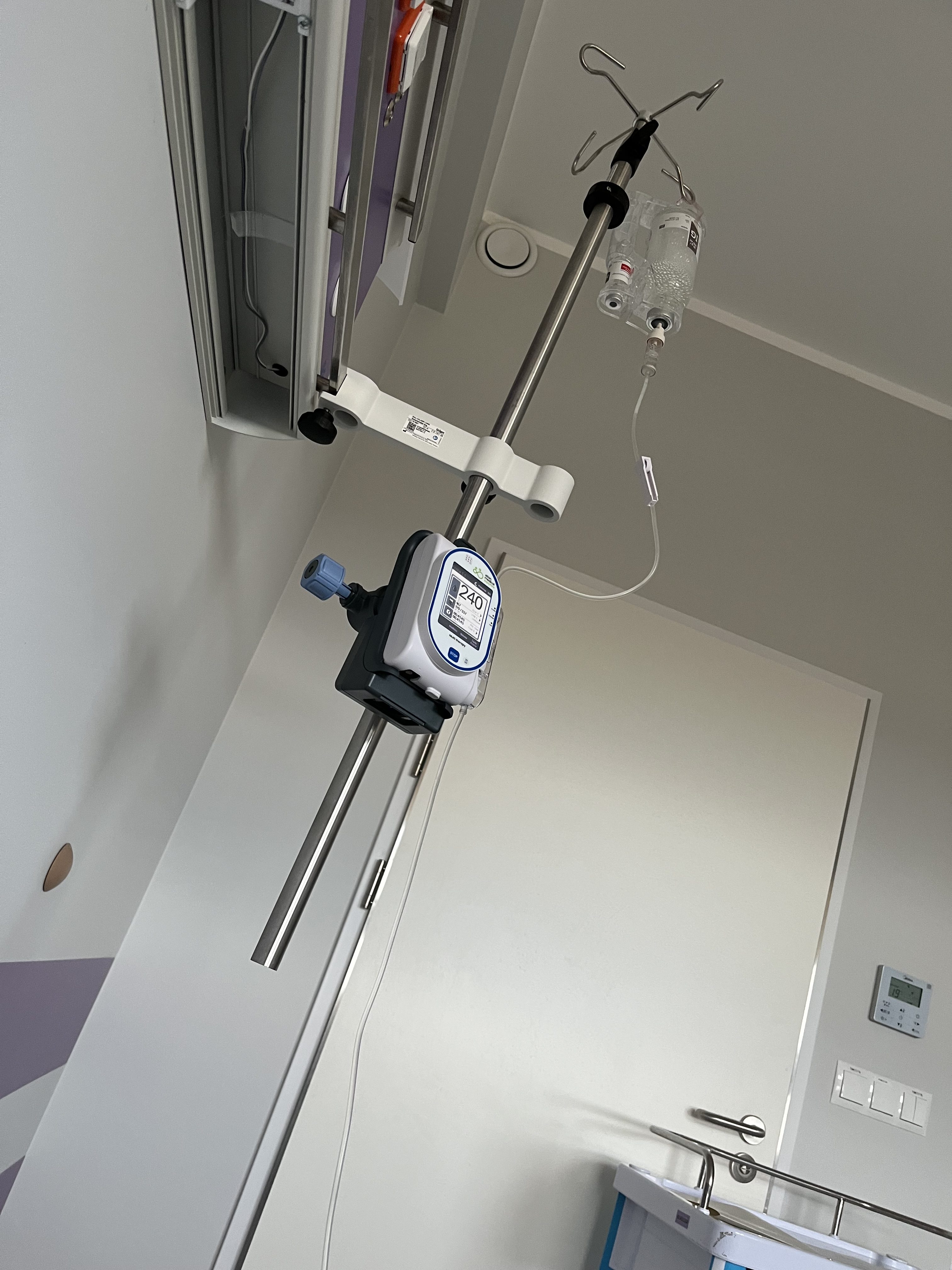
I had to learn to patiently monitor the level in the IV drip, then call a nurse to be able to change the bottle at the right moment.
The thing is that the level in the drip chamber cannot fall to the bottom, because that would mean changing the infusion line, which would result in the loss of a very hard-to-obtain and therefore valuable medication.
And as I was learning all this, I remember sweating buckets and silently begging the lurking headache and dizziness to wait for a better moment.
Surprisingly, it actually waited — politely biding its time — only to show up later and have a full-blown party: a pounding headache, dizzy spells, and that amazing “I might actually hurl any second” feeling.
Not exactly the spa day I had in mind, but the reward was that my left arm and hand started feeling stronger, less shaky. My fingers straightened. Ulnar claw disappeared.
I could finally do things again — simple things, mind you, like typing on a keyboard or using my cellphone with both hands, preparing meals, or handling basic hygiene like washing my hair without constantly calculating how long I could keep my arm raised without pain.
Although IVIg became easier to tolerate over time, I still kept experiencing side effects like headaches, fatigue, grogginess, and the unsettling feeling of being like jelly all over.
I learned how to cope with it.
My basics include painkillers for headaches, a 30-minute daily exercise routine, Nordic walking to improve fitness and promote blood and lymph flow, a diet that eliminates heavily processed foods, proper hydration, supplements for the nervous system, and stress management techniques like breathing exercises, mindfulness, and avoiding people I don’t like.
Over time, I learned how to navigate my IVIg routine, made peace with going to the hospital about six times a year for four days each, and slowly — albeit reluctantly — adapted, adjusted, and picked up the unwritten rules and etiquette of hospital life.
What I described above was yet another important lesson.
I swear I did my best not to be a “nuisance” at Father Pio Hospital, but the truth is — I never came to love IVIg treatment days.
I know that at this point I should feel nothing but relief and gratitude— and I do, especially toward my doctors, the staff and the immunoglobulin treatment itself, which is genuinely helping me with symptoms management and living a better life.
Yet, the thought that this might be forever?
Yeah… that’s kind of, sort of, depressingly overwhelming.
For that reason, when I found out there was a chance to receive treatment at home in the form of SCIg, I saw it as a proverbial light at the end of the tunnel — finally, a little freedom from hospital life!
What Is SCIg?
SCIg stands for Subcutaneous Immunoglobulin.
SCIg is a form of immunoglobulin (Ig) therapy where antibodies are infused under the skin (subcutaneously) rather than into a vein (IV). It’s commonly used to treat conditions involving immune system dysfunction, including CIDP and its variants like Lewis–Sumner Syndrome, as well as primary immunodeficiencies.


My SCIg training began on November 10th with an overnight stay, followed by a second session on November 17th, and the final one on November 24th.
First, I had a routine doctor’s check-up and blood work. Then I went to an assigned room.
The training was led by the nurses, who had to get trained themselves, and watched over by my neurologist — the captain of the whole SCIg operation, who had gone through her own training route just to make sure everything went smoothly.
The first two sessions were also accompanied by a Takeda associate — a very easygoing and knowledgeable lady who, by chance, was also from Lublin (what are the odds?). Takeda is the medical company that provides SCIg pumps to patients in Poland.
I think it is worth mentioning that this entire “SCIg switch team” was female, and they were not just official trainers coaching me — they were also avid cheerleaders, genuinely rooting for me every step of the way.
I felt safe and supported. (I like feeling safe)
My CIDP SCIg training timeline
On November 10th, I received a thorough introduction to the entire SCIg setup — the pump and all the necessary equipment.
The said SCIg Injection Accessories for CIDP Home Therapy provided by Takeda include:
- Syringes and Needles – a “must have” for every infusion
- Subcutaneous Infusion Set: These include pump with soft cannulas, filters, and Luer connectors to help you control your dose.
- Extra Accessories: Think disinfectant pads, adhesive patches, and stands, all designed to make home SCIg therapy easier.
- A special mat to lay out all the necessary accessories, helping to better organize the infusion process.
- A book with step-by-step instructions on how to perform SCIg
- An infusion diary where I record details about each bottle, such as serial numbers, and even stick on labels for reference.
- QR code for instructional materials for subcutaneous infusion by Takeda.
During my first day of SCIg training, the nurses administered most of the treatment — the only thing I did myself was insert the needles into my abdomen.
I first received a hyaluronidase injection to create space for the immunoglobulin, and then 30g/300ml of HyQvia.
My stomach got swollen, and I got a little shocked by it. It was painful.
It all took between 3-4 hours.
I was utterly exhausted, both physically and emotionally.
Doubts crept in — could I really manage this whole ordeal correctly?
There were so many details to remember, and on top of that, strict disinfection had to be maintained at every stage of self-administration.
And everything required two hands to handle — yet I only have one fully functioning hand, while my left side remains weaker from the illness.
By the second day (a week later), I was already doing most of it myself, though still under the watchful eyes of the nurses.
Again: first received a hyaluronidase injection and then 30g/300 ml of HyQvia.
Again: my stomach got swollen, but I got a little less shocked by it. It was less painful compared to the first time.
Same nervous thoughts.
On the third session the Nov 24th, I was supposed to do everything myself, though the nurses still popped in to help with the parts I wasn’t completely confident about.
On the last day, I got a double portion of hyaluronidase so I could get two bottles of HyQvia immunoglobulins 30g/300ml each.
It wasn’t easy holding the bottle upside down in the air — one hand holding it, the other drawing the HY — and I was sweating cold sweat.
Then I got the advice that I could actually hook it onto the IV stand. That little tip was a game-changer.
Again, my stomach ballooned up — I looked like a pregnant manatee — and I was proportionally shocked by the sight.
It hurt, but I knew to expect it, so I’m slowly making peace with this charming little SCIg side effect.
A small price to pay for home infusions, I decided.


(photos: my second SCIg stomach vs third when the dosage was doubled)
After this third session, I left with a fancy Takeda cooler filled with my HyQvia medication, the SCIg pump set up for my specific needs, and all the necessary gear. I came home late in the evening—sore, exhausted — but genuinely happy.

Twice in December 2025, I’ll be giving myself SCIg at home.
How do I feel about it one might ask?
I feel like a person silently screaming inside Munch’s The Scream.
BUT I AM SO READY!

Photo source: https://en.wikipedia.org/wiki/The_Scream
Disclaimer: Everything shared here comes from my own journey with CIDP and is meant for reflection and support, not medical guidance—your healthcare team is always the best source for personal medical decisions.
CARING IS SHARING – IF THIS SUPPORTED YOU IN ANY SMALL WAY, SHARING IT MAY SUPPORT SOMEONE ELSE WITH CIDP, MMN, GBS, OR SIMILAR CONDITION, AND SUBSCRIBING KEEP THIS CIRCLE AND AWARENESS GROWING



Leave a Reply