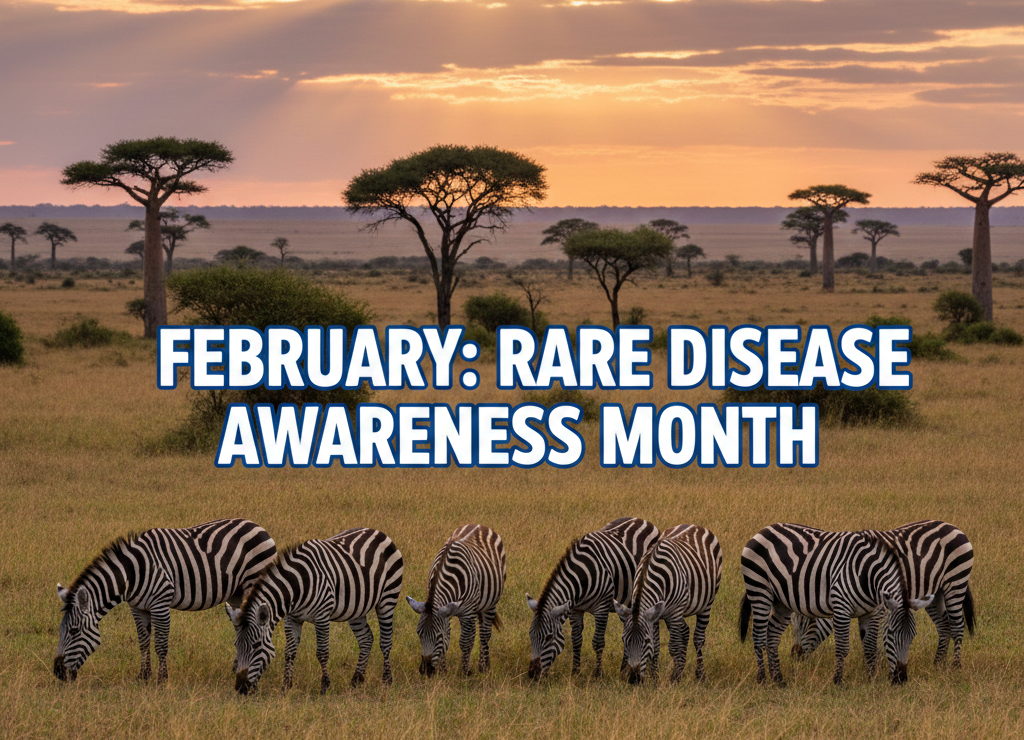
[Photo source: Gemini]
Zebra is the symbol of rare diseases, and when I first wrote a prompt for AI to create an image, my initial thought was just… make a zebra. But then I paused.
Why settle for plain?
Zebras don’t just exist — they thrive in a demanding, harsh environment.
And yet, they also live on a fascinating continent: Africa.
A place full of sun, light, warmth and beauty; a land of mystery, magnetism, and breathtaking nature.
To me, the zebra perfectly reflects the experience of living with a rare disease: resilience in the face of challenge, uniqueness, and a strength that deserves to be celebrated.
I also intentionally included a herd in the image — because living with a rare disease can feel incredibly lonely at times.
The herd reminds me that even in tough, demanding environments, there’s power, connection, and safety in numbers.
It’s a little symbol that we’re not alone, that others are walking similar paths, and that community — even virtual or imagined — can make the journey a bit lighter.
So let’s move on to the point of this post…
It’s Valentine’s Day today — hearts, chocolates, and all the pink-and-red vibes everywhere.
But for me, February also carries another meaning: it’s Rare Disease Awareness Month.
This month hits differently when you live with a rare condition like CIDP or its variant, Lewis-Sumner syndrome.
While the world celebrates love in all its forms, I’m reminded of the quiet kind of love that sustains those of us navigating rare diseases — the patience we give ourselves, the care we receive from friends and family, and the solidarity of communities that truly understand what it’s like to be rare.
Today I am here to honor every small victory, every moment of resilience, and every effort to be seen and heard in a world that doesn’t always notice the rare ones.
February: Rare Disease Awareness Month — Seen, Heard, and Still Here
I’ve been “rare” for years—living with CIDP and Lewis-Sumner syndrome—but this is actually the first time I’ve learned that February is Rare Disease Awareness Month, with Feb 28th chosen to be Rare Disease Day.
On paper, it’s an international campaign dedicated to the more than 300 million people worldwide living with one of over 7,000 rare diseases.
But for those of us living with a rare condition, February isn’t just a date on the calendar. It’s a moment to breathe out and say: We exist. Our lives matter. Our stories are real.
The invisible weight of being “rare”
Living with a rare disease can feel lonely in a very specific way.
You may spend years feeling like a medical mystery, bouncing from doctor to doctor, collecting partial answers and polite shrugs.
You learn a new language of acronyms and test results.
You get used to explaining your condition to people who have never heard of it—sometimes including healthcare professionals.
There’s a strange mix of validation and grief when you finally receive a diagnosis. On one hand, there’s relief: I’m not imagining this. There’s a name for what’s happening to me.
On the other, there’s the heavy realization that “rare” often means limited research, fewer treatment options, and a smaller community to lean on in everyday life.
And yet, despite all that, people living with rare diseases keep showing up for their lives.
We find ways to adapt.
We grieve what’s changed.
We celebrate small wins that might look invisible to others: a day with less pain, a treatment that finally helps, the simple joy of having enough energy to go for a walk or meet a friend.
Why awareness still matters
It’s easy to roll your eyes at “awareness months.”
Another color ribbon. Another hashtag.
Another well-meaning post on social media. But awareness is often the first crack in a wall that’s been standing for far too long.
I actually saw a reel the other day poking fun at another “awareness” campaign. I couldn’t stop laughing — the girl was creative, funny, and her comedic timing was perfect.
But deep down, I felt a little guilty for laughing.
Because even though it was hilarious, I know how important awareness really is.
For rare diseases, awareness can literally mean faster diagnosis, better treatment, and a little more understanding for people who are often overlooked.
It reminded me that humor and seriousness can coexist, and that it’s okay to laugh — as long as we don’t lose sight of why these campaigns matter.
Many people with rare diseases wait years—sometimes decades—for answers.
During that time, symptoms can get worse — like mine have — with some nerves permanently damaged and ongoing changes that accumulate over time.
On top of that, patients are often told, either directly or subtly, that it’s “just stress” or “all in their head.”
Not to mention the medical trauma we endure, along with the heavy emotional toll of realizing that some of this is permanent, and that life as we knew it may never fully return.
Awareness helps medical people recognize patterns sooner.
It helps families advocate more confidently.
It helps patients feel less alone in their confusion.
Awareness also pushes research forward. Rare diseases, by definition, don’t have large patient populations.
That makes them less attractive for funding, less visible in medical training, and easier to overlook in health policy.
When rare disease communities come together—sharing stories, participating in research, showing up to events—they remind the world that “rare” doesn’t mean “insignificant.”
The power of being seen
I think one of the most healing things about rare disease communities is the sense of recognition.
There’s something deeply comforting about meeting someone who just gets it without needing a long explanation.
Someone who understands why you cancel plans last minute, why you celebrate “boring” lab results, why your energy comes in unpredictable waves.
Online groups, patient forums, and awareness campaigns became lifelines for me.
They’re places where I can say, “This is hard,” and be met with understanding instead of awkward silence.
Where you can ask, “Is this normal?” and hear a chorus of “Yes, you’re not alone.”
Where you can share a small victory and have it genuinely celebrated.
Small acts, real impact
You don’t have to be a patient, a doctor, or a researcher to be part of this month in a meaningful way. Awareness doesn’t have to be loud to be powerful.
Sometimes it looks like learning about a condition you’ve never heard of. Sometimes it’s sharing a story that moved you.
Sometimes it’s simply listening when someone talks about their health without trying to fix it.
If you live with a rare disease, participation can look different.
It might mean sharing your story publicly—or choosing not to, because protecting your energy is also a valid form of self-care.
It might mean wearing stripes, lighting a candle, or quietly acknowledging yourself for making it through another year in a body that demands extra patience.
There’s no one “right” way to show up. Your existence alone is already an act of resilience.
Holding space for hope (without toxic positivity)
Hope in the rare disease world is complicated.
It’s not the glossy, inspirational-poster kind of hope. It’s more grounded I’d say.
It’s the hope that research will continue.
That treatments will improve.
That future patients might get answers sooner than you did.
At the same time, it’s okay to admit that some days are heavy.
Awareness months can bring up grief for what’s been lost or what might never fully return.
I do experience grieving days — in fact, I’m in the middle of one of those bouts right now.
It’s stressful, sad, overwhelming, but on the other hand, grieving is part of the process
Giving yourself permission to feel it doesn’t make you weak — it makes you human.
Both hope and grief can coexist. You don’t have to be endlessly positive to be worthy of care, support, or visibility.
I had to learn to look at things from that angle — otherwise, I probably would have ended up adding Xanax to my medication/supplement regimen.
To those living with rare diseases
If you’re reading this and living with a rare condition, know this: you are not invisible, even if the system has sometimes made you feel that way.
Your experience is real.
Your fatigue is real.
Your frustration, your courage, your persistence—all of it counts.
You are more than your diagnosis.
But your diagnosis also deserves to be taken seriously.
This month, whether you speak out or stay quiet, whether you educate others or simply rest, you are part of a global community of people navigating something most of the world never has to think about.
There is strength in that shared, unchosen bond.
So here’s to You CIDP Warriors.
Here’s to the tired caregivers, the persistent advocates, and the bodies that keep showing up despite it all.
We are here.
And we matter.
Hang in there 🐢
Sharing is caring – if this supported you in any small way, sharing it may support someone else with CIDP, and subscribing keeps this circle of healing and awareness growing.



Leave a Reply