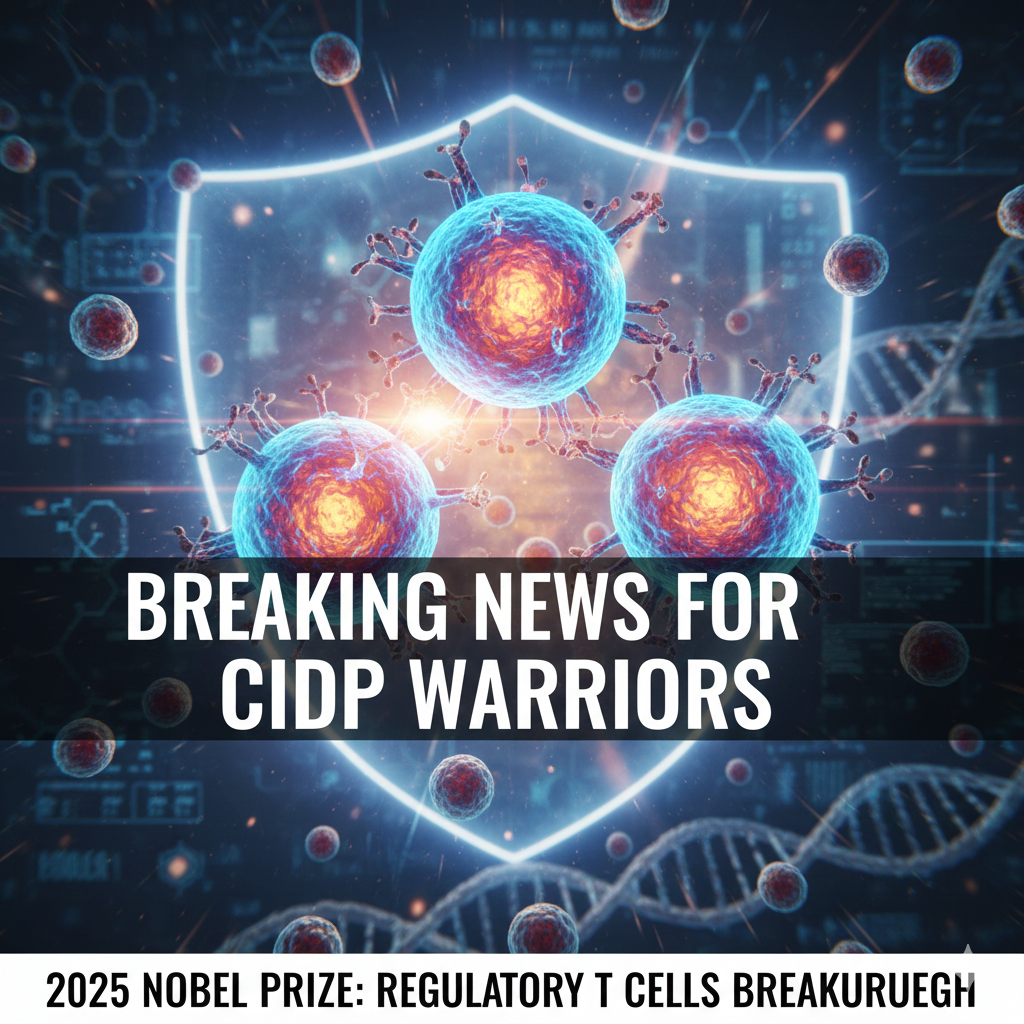
I know this happened weeks ago, but I just stumbled across it—and as they say, better late than…later!
On October 6th, 2025, the Nobel Prize in Physiology or Medicine went to Mary E. Brunkow, Frederick J. Ramsdell, and Shimon Sakaguchi.

Photo: Cecilia Odlind / Karolinska Institutet (via NobelPrize.org)
They were recognized for their groundbreaking work on regulatory T cells—the immune system’s peacekeepers that help prevent autoimmune diseases.
Their research showed how these “security guard” cells in our immune system keep things in check, stopping immune reactions that might otherwise attack our own tissues. Basically, they help explain why some people never develop autoimmune diseases, even though our bodies are constantly exposed to things that could set off the immune system.
This discovery fundamentally changed our understanding of immune tolerance. Until then, we knew about “central tolerance”, where the thymus (a small organ located just behind your breastbone, upper chest) gets rid of dangerous immune cells.
But these researchers showed there’s more to the story—a kind of backup system in the body, a peripheral mechanism, that keeps the immune system in check and helps prevent it from turning against us.
Back in 1995, Sakaguchi discovered this special type of T cell in mice and showed that without these “regulatory” T cells, autoimmune problems can pop up—things like thyroid or pancreatic diseases.
Later on, Brunkow and Ramsdell found that mutations in a gene called Foxp3, which is crucial for these T cells to work properly, make people more likely to develop autoimmune diseases.
Together, their work helped explain how both our genes and these “peacekeeper” cells keep the immune system under control.
For the CIDP community, these discoveries are really encouraging. Many autoimmune neurological conditions, including CIDP, might happen because the “peacekeeper” T cells aren’t working properly or the Foxp3 gene isn’t doing its job. This means that future treatments could focus on boosting or fixing these regulatory T cells, potentially stopping the disease in its tracks instead of just managing the symptoms.
Current treatments for CIDP, like immunoglobulin therapy (IVIG or SCIG), could be better understood thanks to this new research.
This knowledge might even help scientists develop new treatments that work by teaching the immune system to calm down and stop attacking the body, rather than just easing the symptoms.
This breakthrough has already sparked hundreds of clinical trials testing ways to boost or adjust regulatory T cells to treat autoimmune diseases.
It’s an exciting hint that in the future, we could see more personalized and effective treatments not only for conditions like CIDP, but many more from the autoimmune family.
It validates that autoimmune attacks are not inevitable or mysterious but potentially controllable biological problems with precise immune system targets.
With great sadness and regret, I must confess that my mind is too weak to grasp science of such grand caliber, with all its fancy words and phrases – can’t help it, born this way…
(It even took me a while just to learn how to say the whole CIDP name—it’s a real mouthful!)
But you know what?
IT DOES NOT MATTER IF I GET THE LINGO OR NOT
Who cares about the big, mysterious words?
I got the gist, and that’s enough for me!
I’m really HAPPY and EXCITED about this discovery, despite my confusion; it just sounds so hopeful.
What matters is that the 2025 Nobel Prize winners discovered the biological “brakes” that stop the immune system from attacking our own nerves and tissues.
This breakthrough gives hope for future treatments that could actually target the root cause of CIDP and similar autoimmune diseases, instead of just managing the symptoms.
And let’s be honest—don’t we all dream about that happening, like, all the time?
Sources:
- https://www.ajmc.com/view/2025-nobel-prize-in-medicine-honors-discoveries-behind-regulatory-t-cells
- https://www.cnn.com/2025/10/06/science/nobel-prize-medicine-brunkow-ramsdell-sakaguchi-immune-system-intl
- https://www.nobelprize.org/prizes/medicine/2025/popular-information/
- https://www.nature.com/articles/d41586-025-03193-3
- https://www.npr.org/2025/10/06/g-s1-92178/medicine-nobel-prize-peripheral-immune-tolerance-brunkow-ramsdell-sakaguchi
- https://hemostasistoday.com/innovation/2025-nobel-prize-13760
- https://www.science.org/content/article/medicine-nobel-researchers-who-studied-how-body-polices-immune-system
- https://www.neurologylive.com/view/biomarker-subgroup-insights-novel-cidp-therapy-riliprubart-luis-querol
- https://www.gavi.org/vaccineswork/nobel-prize-awarded-discovery-immune-systems-security-guards
- https://pmc.ncbi.nlm.nih.gov/articles/PMC12034639/
- https://www.nobelprize.org/prizes/medicine/2025/press-release/?utm_source=chatgpt.com
- https://texasneurorare.org/p/texas-neurorare-tnr-558a?utm_source=Texasneurorare.org&utm_medium=newsletter&utm_campaign=texas-neurorare-tnr&_bhlid=b97d1849516683af16a36929a7b299b645348e15



Leave a Reply