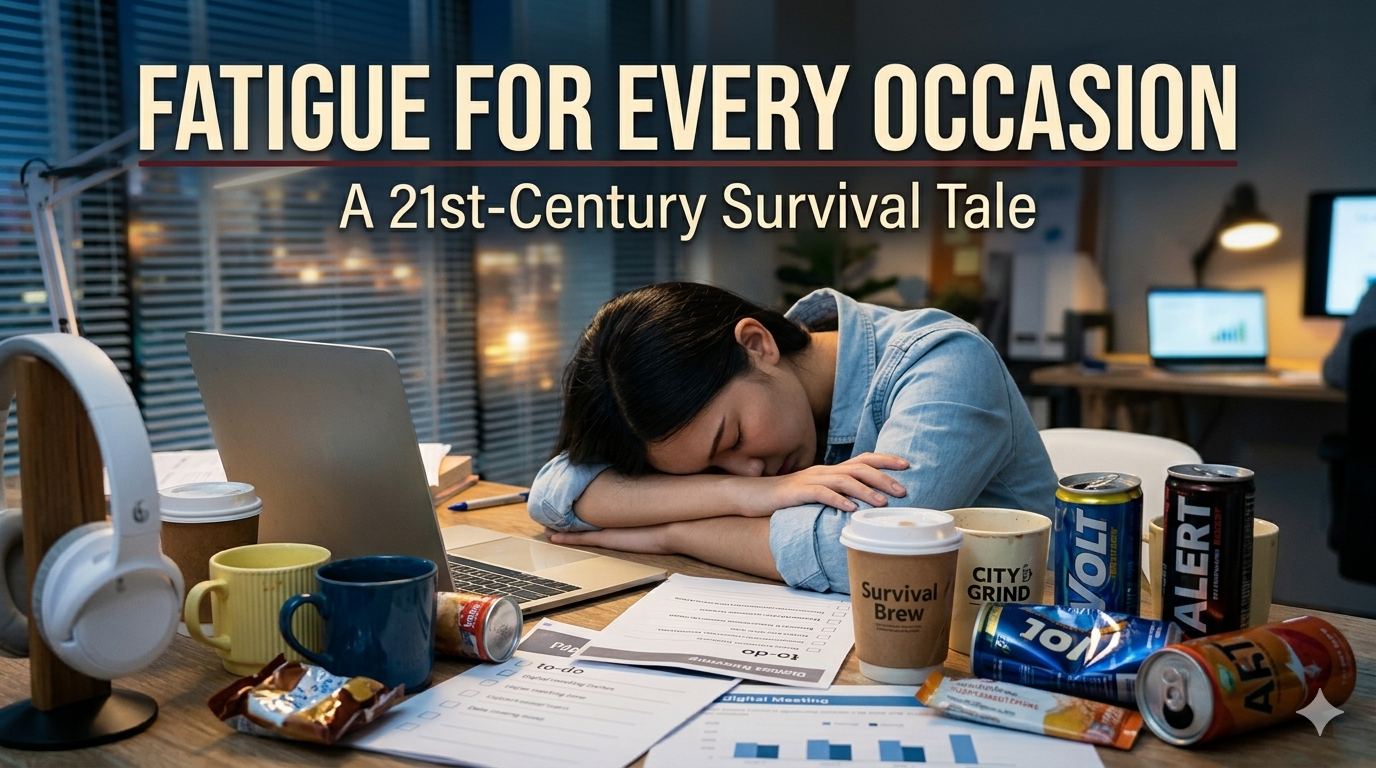
The Many Faces of Tiredness
Come spring, I started feeling a bit more fatigued than I could handle.
I began searching for innovative ways to tackle it—and suddenly, I catapulted myself into a world of fatigue I didn’t even know existed.
I was shell-shocked by how many types of fatigue there are, and couldn’t help but marvel at all the names we’ve invented to categorize them.
We basically have fatigue for every occasion: chronic fatigue, medical testing fatigue, digital fatigue, compassion fatigue, information fatigue, decision fatigue…
Fatigue for every season, plus (a bit of a niche) – heat and cold fatigue if seasonal fatigue does not suffice.
We often say, “I’m tired of being tired,” so apparently, we even have fatigue fatigue.
If someone is determined to feel tired, the fatigue bar is very well stocked.
But I do feel a little guilty for being cynical about it—especially since I know this feeling well.
I haven’t counted for fear of another shock today, but I probably have about ten different types of fatigue myself that I actively try to push against.
Pushing back against fatigue will fatigue you big time, because the whole anti-fatigue plan has to be custom-made.
Tailored to your lifestyle, your specific needs, the disorders you struggle with (and in today’s world, there is barely anyone without some kind of disorder), and even the place where you live.
Say you’re in Tokyo or New York City, for example, regular grounding or forest bathing might be a bit more complicated than for someone living near a park or a forest.
If you live in rural Slovakia, on the other hand, and want to join a Central Park–style tai chi group, the chances are… well, let’s just say they’re pretty slim.
Then there are your allergies, your body type, your job, your family life, your work… the list goes on.
So I’d say the fatigue game—if you really want to figure it out—takes time and determination.
But to land this little rant on a positive note, I just want to say: once you figure it out, it’s well worth it.
You’ll learn how to keep your fatigue at bay. You’ll learn to be more mindful of it. You’ll learn what works best for you. Just keep trying.
Each of us carries a unique set of fatigues, shaped by our health, our environment, our responsibilities, and the ways we cope—so the ways we respond to them have to be just as individual.
As I’ve already mentioned, fatigues can vary—because we are complex beings, living complex lives in a world that is layered, dynamic, and ever-changing.
However, there are some points where all fatigues meet—and silently, if begrudgingly, agree.
Common ground most fatigues share:
Energy depletion – whether physical, mental, or emotional, fatigue almost always comes down to the body and mind running on an empty tank.
Chronic stress on the system – fatigue usually builds when the nervous system stays in a prolonged state of pressure: worry, illness, work demands, caregiving, or uncertainty.
Poor or disrupted recovery – sleep problems, irregular routines, or simply not having enough time to recharge can slowly drain resilience.
Decision overload – many fatigues involve constantly making decisions: medical choices, work tasks, caregiving responsibilities, or daily problem-solving.
Emotional weight – worry, frustration, grief, or responsibility often sit quietly underneath fatigue and make it heavier.
Loss of balance – fatigue tends to appear when one part of life consumes too much energy and there’s not enough restoration (rest, movement, nature, connection).
Cumulative effect – fatigue rarely arrives in one dramatic moment. It usually builds slowly, layer by layer.
The need for personalized recovery – what restores one person may not restore another, which is why managing fatigue often requires a very individual approach.
Of course, we don’t have to experience all of these at once.
Some may show up more strongly, others only faintly, depending on our circumstances, the way we cope, and the resources we have available to us.
First-Aid Responses: Diet, Exercise, and Stress Management
POV – when it comes to fighting fatigue, the first things to try are usually the basics: diet, exercise, and stress management.
Diet
Diet can influence fatigue in several key ways beyond just fueling the body:
- Stabilizes blood sugar – Eating balanced meals with protein, fiber, and healthy fats prevents energy crashes that worsen fatigue.
- Reduces inflammation – Chronic fatigue, autoimmune conditions like CIDP, and general tiredness are often worsened by systemic inflammation. Anti-inflammatory foods (like fatty fish, leafy greens, berries, turmeric) can help ease this.
- Supports nerve health – Certain nutrients, like B vitamins, magnesium, and omega-3s, help repair or maintain nerve function, which is especially important in neurological fatigue.
- Improves digestion and nutrient absorption – A healthy gut allows the body to extract more energy and nutrients from food, which can counteract fatigue caused by deficiencies.
- Boosts mood and mental energy – Diet influences neurotransmitters and hormones, so nutrient-rich meals can help reduce emotional fatigue, brain fog, and even pessimism.
- Hydration balance – Adequate water and electrolyte intake prevent fatigue from dehydration, which is surprisingly common.
- Supports immune function – A strong immune system means fewer infections, less post-illness fatigue, and faster recovery from everyday stressors.
Exercise
It may feel counterintuitive, but moving when you’re tired can actually reduce both physical and mental fatigue.
Here’s what it does:
- Boosts energy production – Exercise strengthens muscles and improves cardiovascular efficiency, so your body becomes better at generating and distributing energy.
- Enhances circulation – Better blood flow delivers oxygen and nutrients to tissues (including nerves and the brain), helping fight fatigue.
- Supports nerve and muscle health – Especially important for chronic illness or neurological fatigue, gentle resistance or mobility exercises can maintain strength and prevent deconditioning.
- Improves sleep quality – Regular movement can help regulate sleep patterns, which is critical for recovery from fatigue.
- Releases “feel-good” chemicals – Endorphins, dopamine, and serotonin released during exercise help combat mental fatigue, brain fog, and low mood.
- Reduces stress – Physical activity lowers stress hormones like cortisol, easing emotional and cognitive fatigue.
- Builds resilience – Over time, consistent exercise helps your body adapt to physical and mental stressors, so you’re less drained by everyday challenges.
Stress Management
Stress management methods reset your nervous system and are key to fighting fatigue, since stress often fuels it.
Here’s how these techniques help:
- Calms the nervous system – Practices like meditation, deep breathing, or yoga reduce the “fight or flight” response, lowering cortisol and adrenaline, which are major contributors to chronic fatigue.
- Improves sleep and recovery – Less stress means your body can enter deeper, more restorative sleep cycles, allowing real energy replenishment.
- Reduces mental overload – Mindfulness and relaxation exercises help clear cognitive clutter, easing decision fatigue and mental exhaustion.
- Supports emotional resilience – Stress management gives you tools to cope with worry, caregiver duties, or chronic illness challenges without letting them sap all your energy.
- Encourages healthier habits – When stress is under control, people are more likely to eat well, move their body, and stick to routines that prevent fatigue from spiraling.
- Interrupts the fatigue cycle – Stress and fatigue feed each other. Managing stress breaks this loop, making it easier to regain energy and motivation.
The Realities of Living With Chronic Fatigue
I really don’t want to make it sound easy.
I know it takes a lot of auto-diagnosis.
I know how impossible it can feel to get your ducks in a row, how stubbornly habits can cling in our brains, and how elusive mindfulness feels when life is a whirlwind and you’re being carried along by powerful currents, barely feeling in control.
Believe me, I know.
And how do I know?
Experience, of course.
I live with CIDP, and as someone who has survived plenty of the bullshit life can generously throw at you, I can honestly attest to this: when I eat like there’s no tomorrow (and yes, I do—vacations, holidays, traveling), when I skip exercise for a few days because I’m on the move, or when I lose track of my stress responses—things can unravel pretty quickly.
And stress management is the hardest part of all, because it lives in the mind.
You’re dealing with both the conscious and the unconscious, old habits and new reactions, emotions you understand and others you barely recognize.
It can feel like trying to steer a raging bull in the middle of a rodeo.
It’s a wild ride sometimes.
When that happens, all my fatigues run rampant, draining everything out of me—sometimes even my will to keep going.
And when that happens, when the usual tools fail me, there is one more place I turn: my spirituality.
I was raised Catholic. Over the years, I drifted away from the formal doctrine, but I kept my Christian beliefs close to my heart.
And there have been moments—very humbling and more than a few—when diet, exercise, and all my carefully assembled stress‑management tricks simply weren’t enough.
In those moments of deep fatigue, when I felt emptied out, I turned to prayer as a last resort. And somehow, quietly and gently, it brought a kind of relief that is hard to explain.
Not a dramatic miracle, not an instant cure—but a soft sense of being held, of not carrying everything alone.





Leave a Reply